


UPSC IAS Syllabus is released by the Union Public Service Commission (UPSC) on the official website in PDF format. The UPSC IAS is generally divided into two parts, i.e., Prelims and Mains. Candidates preparing for the UPSC exam should be well versed with the UPSC IAS syllabus 2022 before they start their preparation. Nowadays it has become easier to get UPSC online syllabus. Candidates are requested to continuously stay updated with the website.
The UPSC exam is considered the toughest of all the exams, and the UPSC IAS syllabus is considered vast and difficult to cover. Hence, the aspirants must be thorough with the syllabus and plan the preparation for the UPSC exam in a strategic manner.
Candidates can refer to the UPSC online to check for changes in the syllabus but according to the latest update there is no change in the UPSC IAS 2022 syllabus; it is similar to the previous year’s syllabus. Aspirants can download the UPSC IAS syllabus in PDF form from the official website of the Union Public Service Commission.
Prelims is the first stage of the UPSC exam, and aspirants have to qualify to appear for the Mains exam. After the candidates clear the Mains exam, selected candidates are called to appear in the Interview round. To ensure that you are totally prepared for the UPSC exam, you must complete the UPSC IAS syllabus and then begin your preparation.
UPSC IAS Exam 2022: Prelims Syllabus
The Union Public Service Commission conducts the Civil Services Examination (CSE) to select candidates for the various posts, namely IAS, IPS and IFS. In the UPSC exam. Candidates are suggested to go through the UPSC IAS syllabus thoroughly to qualify for the exam.
Aspirants should appear for the two papers of the Civil Services Prelims Examination. The minimum qualifying mark is 33%. There is a negative marking scheme. 1/3 of the marks will be deducted for every incorrect answer.
| Details regarding Paper | Number of Questions | Marks | Duration |
| General Studies Paper 1 (GS) | 100 | 200 | 2 hours |
| General Studies Paper 2 (CSAT) | 80 | 200 | 2 hours |
| Total | 180 | 400 | 4 hours |
UPSC IAS Syllabus for Prelims Exam: Paper 1 (GS)
The detailed UPSC IAS Syllabus for Prelims exam Paper 1 is mentioned below. The aspirants are suggested to make proper strategic preparation tips for the UPSC IAS exam as it is considered to be a very tough and vast exam.
- Current events of national and international importance
- History of India and the Indian national movement
- Indian and world geography-physical, social, economic geography of India and the world
- Indian polity and governance-Constitution, political System, Panchayati Raj, public policy, rights issues, etc.
- Economic and social development-sustainable development, poverty, inclusion, demographics, social sector initiatives, etc.
- General issues on environmental ecology, biodiversity and climate change – that do not require subject specialisation.
- General Science
UPSC IAS Syllabus for Prelims Exam: Paper 2 (CSAT)
The detailed UPSC IAS Syllabus for the Prelims exam Paper 2 is mentioned below. This paper is considered to be qualifying, and the marks of this paper are not counted in the final selection of the Mains UPSC IAS exam.
- Comprehension interpersonal skills, including communication skills
- Logical reasoning and analytical ability
- General mental ability
- Basic numeracy (numbers and their relations, orders of magnitude, etc.) (Class X level),
- Data interpretation (charts, graphs, tables, data sufficiency etc. — Class X level).
UPSC IAS Exam 2022: Mains Syllabus
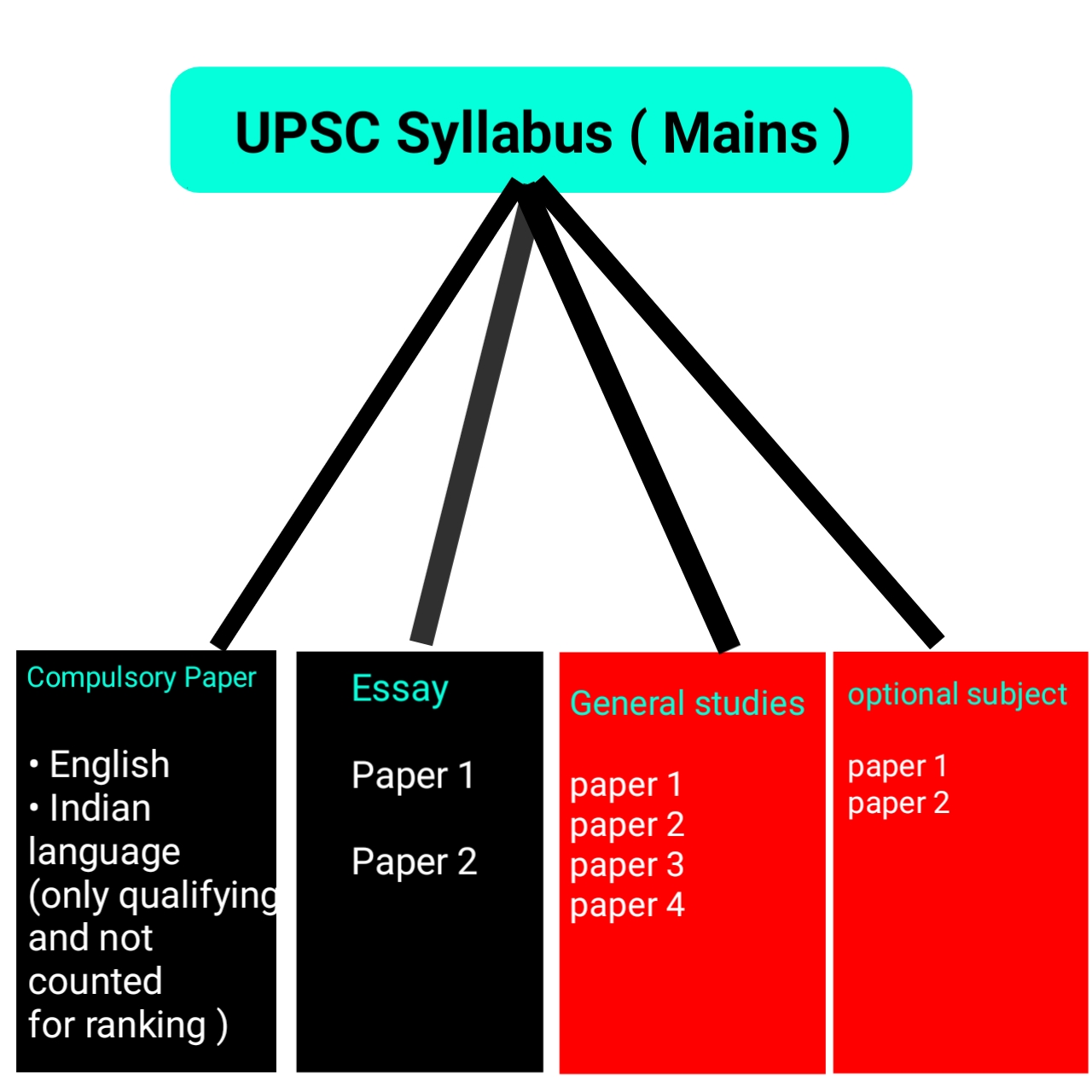
The Union Public Service Commission releases the list of the selected candidates for the Mains exam. Aspirants should be thoroughly aware of the Mains UPSC IAS Syllabus. They should also keep in mind that the Main exam is the most important stage for IAS selection. The Mains exam consists of nine papers, and they are descriptive in nature. Candidates can also get this syllabus in UPSC online portal.
| Paper | Subject | Duration | Total marks |
| Paper A | Compulsory Indian Language | 3 hours | 300 (Qualifying) |
| Paper B | English | 3 hours | 300 (Qualifying) |
| Paper I | Essay | 3 hours | 250 |
| Paper II | General Studies I – Indian Heritage & Culture, History & Geography of the World & Society | 3 hours | 250 |
| Paper III | General Studies II – Governance, Constitution, Welfare Initiatives, Social Justice & International Relations | 3 hours | 250 |
| Paper IV | General Studies III – Technology, Economic Development, Agriculture, Biodiversity, Security & Disaster Management | 3 hours | 250 |
| Paper V | General Studies IV – Ethics, Integrity & Aptitude | 3 hours | 250 |
| Paper VI | Optional Subject – Paper I | 3 hours | 250 |
| Paper VII | Optional Subject – Paper II | 3 hours | 250 |
UPSC IAS Syllabus for Mains Exam: Compulsory Indian Language
The UPSC IAS syllabus for Compulsory Indian Language papers is set as only qualifying papers in the UPSC exam. Aspirants should be careful enough and should not score below 25% because the rest of the papers would not be evaluated. The syllabus for the compulsory Indian Language is given below.
- One essay question for 100 marks
- Reading comprehension and related five-six questions for a total of 60 marks
- Precis writing for 60 marks
- Translation from English to chosen language for 20 marks
- Translation from chosen language to English for 20 marks
- Grammar and basic language usage such as synonyms, sentence correction etc., for a total of 40 marks
UPSC IAS Syllabus for Mains Exam: Essay
The UPSC IAS Syllabus for Mains does not have any stipulated syllabus for the essay paper of the UPSC exam. As per the Union Public Service Commission, the aspirants are required to write close to the topic with creative ideas and in a concise manner.
Candidates will be assigned to write two essays from the given list of topics, and the marks allotted are 250 marks.
UPSC IAS Syllabus for Mains Exam: Paper 1
The detailed UPSC IAS Syllabus for Mains exam Paper 1 is mentioned below. The aspirants are suggested to make proper strategic preparation tips for the UPSC exam. Indian Culture – salient aspects of art forms, literature and architecture from ancient to modern times
Modern Indian History
- Significant events, issues, personalities during the middle of the eighteenth century (the 1750s) until the present
- Different stages and important contributors and contributions from various parts of the country in The Freedom Struggle.
- Post-independence consolidation and reorganisation within the country
History of the World
- Events, forms and effects on society since the 18th century (world wars, the industrial revolution, colonisation, redraw of national boundaries, decolonisation, political philosophies like communism, capitalism, socialism, etc.)
Society
- Indian society and diversity – Salient aspects
- Role of women and women’s organisations, population and associated issues, poverty and developmental issues, urbanisation, their problems and remedies
- Social empowerment, communalism, regionalism and secularism
- Effects of globalisation on Indian society
Geography
- Distribution of key natural resources across the world, including South Asia and the Indian sub-continent; factors responsible for the location of primary, secondary, and tertiary sector industries in various parts of the world, including India
- Important Geophysical phenomena such as earthquakes, tsunamis, Volcanic activity, cyclones etc
- Geographical features and their location, changes in critical geographical features (including water bodies and polar ice caps), flora and fauna and the effects of such changes
- Salient features of the world’s physical geography
UPSC IAS Syllabus for Mains Exam: Paper 2
The detailed UPSC IAS syllabus for Mains exam Paper 2 is mentioned below. Indian Constitution
- Historical underpinnings
- Evolution and features
- Amendments and significant provisions
- Basic structure doctrine
- Comparison of the Indian Constitutional scheme with that of other countries
- Functions and responsibilities of the Union and the States, issues and challenges pertaining to the federal structure, devolution of powers and finances up to local levels and challenges therein
- Separation of powers between various organs, dispute redressal mechanisms and institutions
- Structure, organisation and functioning of the executive and the judiciary
- Parliament and state legislatures
- Structure and functioning
- Conduct of business
- Powers, privileges and issues arising out of these
- Ministries and Departments of the Government; pressure groups and formal/informal associations and their role in the polity
- Salient features of the Representation of People’s Act
- Appointment to various Constitutional posts, powers, functions and responsibilities of various Constitutional bodies
- Statutory, regulatory and various quasi-judicial bodies
- Government policies and interventions are aimed at development in various sectors, and issues arising out of their design and implementation
- Development processes and the development industry – the role of NGOs, Self Help Groups, various groups and associations, institutional and other stakeholders
- Welfare schemes for vulnerable sections of the population by the centre and the states and the performance of these schemes; mechanisms, laws, institutions and Bodies constituted for the protection and betterment of these vulnerable sections.
- Issues relating to the development and management of social sector/services relating to health, education, human resources
- Issues relating to poverty and hunger
- Important aspects of governance, transparency and accountability, e-governance- applications, models, successes, limitations, and potential; citizens charters, transparency & accountability and institutional and other measures
- Role of civil services in a democracy
- International relations
- India and its neighbourhood – International relations
- Bilateral, regional and global groupings and agreements involving India and/or affecting the Indian interests
- Effect of policies and politics of developed and developing countries on India’s interests, Indian diaspora.
- Important International institutions, agencies, their structure and mandates
UPSC IAS Syllabus for Mains Exam: Paper 3
The detailed UPSC IAS syllabus for mains exam paper 3 is mentioned below.
Economy
- Indian economy and issues relating to planning, mobilisation of resources, growth, development and employment
- Government budgeting
- Inclusive growth and associated issues/challenges
- Effects of liberalisation on the economy (post-1991 changes), changes in industrial policy and their effects on industrial growth
- Infrastructure – energy, ports, roads, airports, railways etc.
- Investment models (PPP etc.)
Agriculture
- Major cropping patterns in various parts of the country, different types of irrigation and irrigation systems storage, transport and marketing of agricultural produce and issues and related constraints; technology in aid of farmers
- Economics of animal rearing
- Food processing and related industries in India – scope and significance, location, upstream and downstream requirements, supply chain management
- Issues related to direct and indirect farm subsidies and minimum support prices; Public Distribution System objectives, functioning, limitations, revamping; issues of buffer stocks and food security; technology missions
- Land reforms in India
Science and Technology
- Recent developments and their applications and effects in everyday life
- Achievements of Indians in science & technology
- Indigenisation of technology and development of new technology
- General awareness in the fields of IT, space, computers, robotics, nanotechnology, biotechnology
- Issues relating to intellectual property rights
Environment
- Conservation
- Environmental pollution and degradation
- Environmental impact assessment
Disaster Management (Laws, Acts etc.)
Security
- Challenges to internal security (external state and non-state actors)
- Linkages between development and spread of extremism
- Challenges to internal security through communication networks, the role of media and social networking sites in internal security challenges
- Basics of cyber security; money-laundering and its prevention
- Security challenges and their management in border areas; linkages of organised crime with terrorism
- Various security forces and agencies and their mandates
UPSC IAS Syllabus for Mains Exam: Paper 4
The detailed UPSC IAS Syllabus for Mains exam Paper 4 is mentioned below.
Ethics and Human Interface
- Essence of ethics, determinants and consequences of ethics in human interaction
- Dimensions of ethics
- Ethics in private and public relationships
- Human values – lessons from the lives and teachings of great leaders, reformers and administrators
- Role of family, society and educational institutions in inculcating moral and ethical values
Attitude
- Content, structure and function of attitude
- Influence of attitude on thought and behaviour
- Relation of attitude to thought and behaviour
- Moral and Political attitudes
- Social influence and persuasion
Aptitude
- Aptitude and foundational values of Civil Service
- Integrity
- Impartiality and non-partisanship
- Objectivity
- Dedication to public service
- Empathy, tolerance and compassion towards the weaker sections of the society
Emotional Intelligence
- Concepts of emotional intelligence
- Utility and application of emotional intelligence in administration and governance
Contributions of Thinkers and Philosophers
- Contributions of moral thinkers and philosophers from India and the world to the concepts of morality
Public/Civil Service Values and Ethics in Public Administration
- Status and associated problems
- Ethical concerns and dilemmas in government and private institutions
- Laws, rules, regulations and conscience as sources of ethical guidance
- Accountability and ethical governance
- Strengthening of ethical and moral values in governance
- Ethical issues in international relations and funding
- Corporate governance
Probity in Governance
- Concept of public service
- The philosophical basis of governance and probity
- Information sharing and transparency in government
- Right to Information
- Codes of ethics
- Codes of conduct
- Citizen’s Charters
- Work culture
- Quality of service delivery
- Utilisation of public funds
- Challenges of corruption
UPSC IAS Exam 2022: Interview Syllabus
Aspirants who have qualified for the Mains UPSC IAS exam will be called for the final round, i.e., the Personality Test (Interview). The marks allotted for this round are 275 marks. The Interview round will be based on intellectual qualities and also evaluate the candidate’s mental ability.
The Interview round evaluates mental alertness, power of thinking, clear and logical explanation, the balance of judgement, variety and depth of interest, and intellectual and moral integrity. Candidates appearing for the UPSC exam should make themselves prepared with all these qualities.
UPSC IAS Exam 2022: Preparation Tips for IAS Officer
The candidates should be well versed in the important chapters and important areas before appearing in the IAS exam. Candidates should prepare themselves thoroughly so that they can qualify for the exam.
Some IAS Selection Process 2022 is listed below.
- Revise previous years’ question papers
Solving IAS previous years’ question papers is essential for becoming familiar with the subjects that are frequently asked in the exam. This is the smartest way to prepare for the exam, rather than the typical subject-by-subject strategy, which is generally practised in the graduate examination. In this way, candidates will be able to cover a few of the most important topics.
- Familiarisation with the study material
You should be aware of your syllabus and schedule your studies accordingly.
- Organising your time
This means that you should never create a restrictive study plan that includes numerous strict components, such as covering subtopics within a specific time period. Instead, concentrate on completing the study material according to your understanding so that you do not waste time on a shallow understanding of the core issues. Be adaptable while remaining focused on your objectives.
Set a timetable that allows for at least two rounds of revisions.
This not only aids in the development of a perspective on a given topic but also allows one to see how the answers can be framed and how questions are asked in the examination in a variety of ways.
- Making notes is an effective way to learn.
Taking notes and going over them again helps you revise more effectively. Revision from self-made notes is always simple and convenient. It aids in greater retention and memory, as well as provides an advantage in exams.
This is how your IAS preparation plan should look. Stay tuned for more in-depth exam strategy pages so you can optimise your ability and stick to the plan to ace the IAS 2022 exam.
